

With the continuous development of urbanization and industrialization, the demand for efficient and sustainable wastewater treatment systems has become increasingly urgent. One of the critical aspects of wastewater treatment is ensuring that treatment plants can effectively handle the growing volumes of wastewater. The Moving Bed Biofilm Reactor (MBBR) media serves as a solution that can expand the capacity of wastewater treatment plants without the need for constructing entirely new facilities.
What is MBBR?
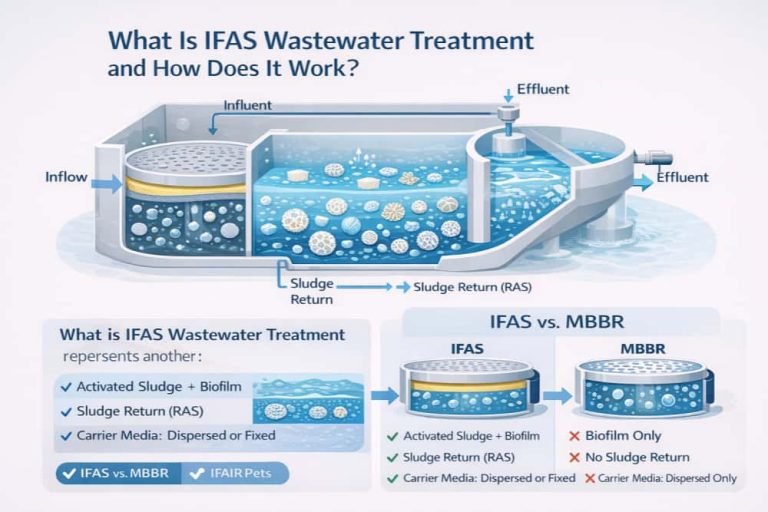
The Moving Bed Biofilm Reactor (MBBR) is a biological wastewater treatment method that utilizes floating plastic biofilm carriers to provide a larger surface area for microbial growth. It is an attached growth process, where a cluster of microorganisms, known as biofilm, breaks down organic materials and pollutants present in wastewater, ensuring effective treatment.
Typically constructed from High-Density Polyethylene (HDPE) with a density close to that of water (0.95 g/cm³), the plastic media is extruded into high-surface-area shapes that facilitate biofilm development. The media is kept in the aeration basin by screens, with excess biosolids being removed during the movement process. While biofilm treatment systems, such as trickling filters, have existed for years, the use of plastic provides more options for supporting biofilm growth.
Advantages of MBBR Media
Compared to conventional wastewater treatment methods, MBBR offers several key advantages:
- High Treatment Efficiency
MBBR systems provide significantly higher treatment efficiency compared to traditional methods. The biofilm carriers in MBBR offer an extensive surface area for microbial growth, enhancing the contact between microorganisms and wastewater. This enables MBBR to more effectively remove organic pollutants, nitrogen, and phosphorus from the water, improving water quality and ensuring compliance with environmental regulations. - Compact Footprint
MBBR systems are designed to be compact, requiring much less space compared to traditional treatment methods. This makes MBBR particularly suitable for retrofitting existing treatment plants and for constructing new plants in areas with limited land availability. - Flexibility and Scalability
MBBR systems can be easily adjusted and expanded based on treatment requirements. The modular nature of the technology allows for future scalability without disrupting the overall treatment process. - Reduced Sludge Production
Due to the use of biofilm technology, MBBR generates less sludge compared to conventional treatment processes. This reduction in sludge production lowers disposal and operational costs associated with sludge management. - Resilience to Shock Loads
The MBBR process exhibits excellent adaptability to fluctuations in wastewater flow and pollutant loads. It can effectively handle sudden changes in organic load, toxic substances, or hydraulic conditions without compromising treatment performance. This adaptability makes MBBR particularly suitable for industrial applications with fluctuating wastewater characteristics. - Energy Efficiency
MBBR systems can be designed with energy-efficient aeration processes. By optimizing the aeration process, energy consumption is reduced, which lowers operational costs and minimizes environmental impact. - Ease of Maintenance
MBBR systems require relatively simple maintenance. The biofilm carriers are self-cleaning, reducing the need for frequent maintenance and cleaning. This results in less downtime and fewer disruptions to plant operations. - Versatility
MBBR systems are highly versatile and can be applied in various fields, including municipal wastewater treatment, industrial wastewater treatment, and decentralized wastewater treatment. The technology is effective in treating a wide range of pollutants and achieving the required effluent quality standards.
Conclusion
MBBR media plays a pivotal role in enhancing the capacity of wastewater treatment plants. With its high treatment efficiency, compact design, flexibility, reduced sludge production, and energy efficiency, MBBR offers an ideal solution for expanding treatment capacity without the need for extensive infrastructure changes. It is an adaptable, scalable, and environmentally sustainable technology that can meet the growing demands of modern wastewater treatment.