

Table of Contents
1. Introduction: The Role of Cooling Towers
Cooling towers are essential components in modern industrial and HVAC systems, serving the critical role of dissipating excess heat generated during various processes. Without efficient cooling towers, systems such as power plants, data centers, and manufacturing operations would struggle to maintain optimal operating temperatures, potentially leading to system failures or increased energy consumption. Cooling towers help maintain energy balance, reduce the burden on chillers, and enable facilities to operate within safe thermal limits, contributing to overall system efficiency and reliability.
2. How Cooling Towers Work
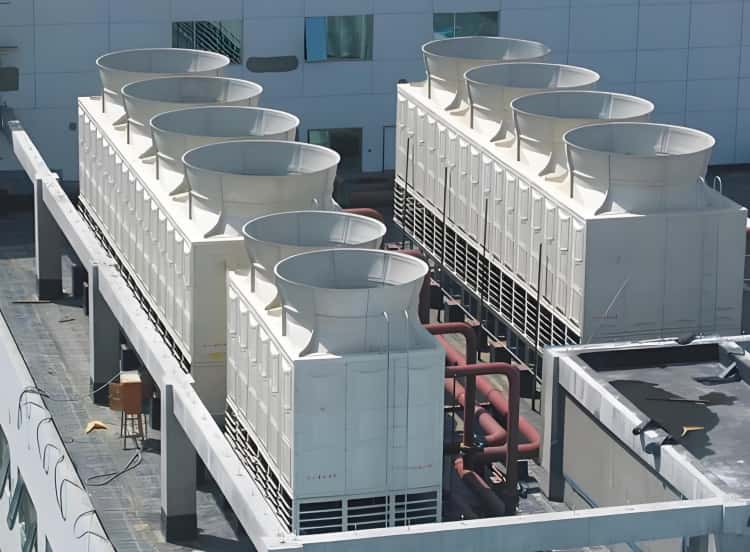
Cooling towers operate using the principle of evaporative cooling. Warm water from industrial equipment or air conditioning systems is pumped into the tower and evenly distributed across fill media. At the same time, air is drawn or pushed through the tower using fans. As air passes over the water, a small portion of the water evaporates, removing heat from the remaining liquid. This cooled water collects in the basin at the bottom of the tower and is pumped back into the system to absorb more heat. The process repeats continuously, allowing for sustainable, cyclical thermal regulation.
3. Key Types of Cooling Towers
Cooling towers are categorized by their airflow patterns and construction. Crossflow towers allow air to flow horizontally across the falling water, offering easy maintenance but a higher risk of freezing in cold climates. Counterflow towers direct air vertically upward, against the downward flow of water, providing better heat transfer efficiency in a more compact footprint. Induced draft towers have fans at the top that pull air upward through the system, whereas forced draft towers have fans at the base that push air inward. Closed-loop cooling towers further reduce water loss and contamination by circulating water through sealed coils, isolating it from the external environment.
4 Understanding Cooling Tower Efficiency
Cooling tower efficiency is a measure of how effectively the tower removes heat from the water relative to its theoretical maximum. This is determined by the range (the temperature difference between inlet and outlet water), and the approach (the difference between outlet water temperature and ambient wet-bulb temperature). The smaller the approach, the more efficient the tower. Efficiency is also influenced by cycles of concentration, which measure the accumulation of dissolved solids. Maintaining high cycles while avoiding scale buildup is key to achieving maximum efficiency without excessive water waste.Efficiency is the ability of the tower to reduce water temperature with minimal energy and water waste. It depends on heat transfer effectiveness, water usage rate, cycles of concentration, and blowdown control. Efficiency is often calculated as:
Effectiveness = Range / (Range + Approach)
5. Factors Affecting Cooling Tower Efficiency
Several variables impact cooling tower performance. These include fan blade design, which affects airflow and energy consumption; water distribution quality, which ensures even cooling; fill media condition, which influences heat exchange surface area; and drive system reliability, which determines operational stability. Additionally, water quality, chemical treatment protocols, ambient weather conditions, and mechanical wear all play a role. Poor maintenance or environmental contamination can significantly degrade tower efficiency over time, making regular monitoring essential. Several factors influence performance:
- Fan design and motor speed
- Water distribution uniformity
- Fill media quality
- Scale buildup and contamination
- Ambient temperature and humidity
6. Strategies to Improve Cooling Tower Efficiency
Improving cooling tower performance involves both equipment upgrades and operational enhancements. Focusing on fan and motor upgrades can yield major energy savings. Optimizing water distribution and using high-performance fill materials improve heat transfer. Automation technologies like variable frequency drives (VFDs) and smart controllers ensure that cooling matches real-time demand. Regular maintenance prevents mechanical failure and contamination. Seasonal adjustments help tailor performance to ambient conditions. Together, these strategies help reduce energy use, improve reliability, and extend system life.

6.1 Fan Design and Drive System Upgrades
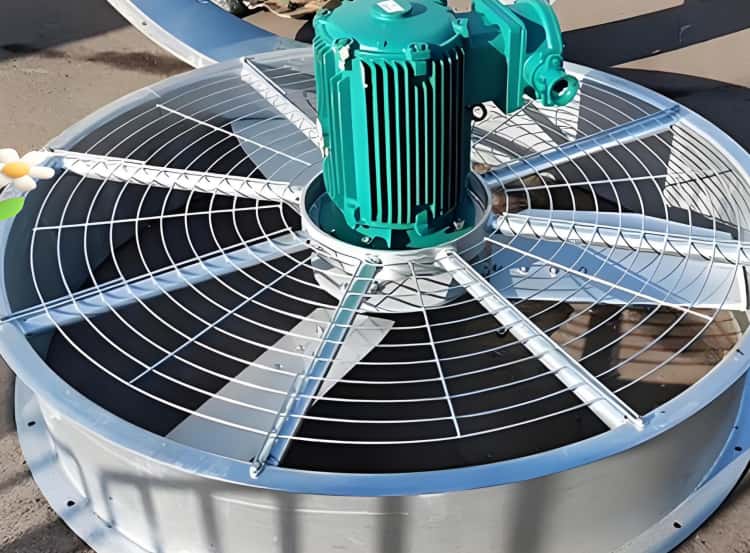
High-efficiency fan blades made from lightweight fiberglass-reinforced plastic offer improved durability and reduced energy consumption. These blades are often designed with aerodynamic profiles to enhance airflow while reducing drag. Integrating variable frequency drives (VFDs) allows fan speed to adjust based on actual cooling demand, significantly lowering energy costs during partial load conditions. Replacing belt or gear-driven systems with direct drives minimizes friction and maintenance needs, increasing the overall mechanical efficiency and longevity of the cooling tower.
6.2 Water Distribution Optimization
Efficient water distribution ensures that all fill surfaces are wetted evenly, maximizing heat transfer. Clogged or misaligned spray nozzles lead to uneven cooling and energy waste. Upgrading to square-pattern, non-clog ABS nozzles improves uniformity. Maintaining proper water pressure and flow rates is essential for optimal performance. Regular inspections of distribution basins and piping help detect and resolve issues early, preventing costly inefficiencies and prolonging equipment life.
6.3 Fill Media and Structural Enhancements
6.4 Smart Controls and Automation
Modern cooling towers benefit greatly from intelligent control systems. These systems monitor environmental data such as temperature, humidity, and load conditions to adjust fan and pump speeds in real time. Automated scheduling based on peak usage periods and remote diagnostics help operators detect anomalies early. Integration with building management systems (BMS) enables predictive maintenance and reduces the need for manual intervention, increasing operational efficiency and uptime.
6.5 Regular Maintenance and Cleaning
Neglecting maintenance leads to scale buildup, clogged nozzles, and reduced performance. A scheduled maintenance plan should include fill media cleaning, motor and gearbox lubrication, and drift eliminator inspection. Vibration sensors can provide early warnings for mechanical issues. Periodic water testing ensures chemical balances are maintained, helping to prevent corrosion and biological growth. Well-maintained cooling towers not only operate more efficiently but also avoid unplanned shutdowns and costly repairs.
6.6 Seasonal and Environmental Adjustments
Adjusting cooling tower operation based on seasonal weather can yield significant savings. During cooler months, fan speeds can be reduced or completely shut off to take advantage of natural air temperatures (free cooling). In windy environments, installing louvers or wind baffles prevents water loss from drift and ensures consistent airflow. These environmental adaptations help maintain optimal efficiency and reduce unnecessary energy consumption throughout the year.
7. Extending Equipment Lifespan
Prolonging equipment life requires proactive care:
- Install vibration sensors to detect fan and bearing wear early.
- Use synthetic lubricants to handle high heat and reduce maintenance frequency.
- Apply corrosion-resistant coatings like epoxy to protect structural components.
- Perform oil analysis during shutdowns to detect contamination or wear.
- Partner with certified repair services for gearboxes and motors to ensure component quality.
8. Conclusion: Why Efficiency Matters
Improving cooling tower efficiency is not just about saving electricity. It directly affects:
- Equipment longevity
- System reliability
- Chiller performance
- Water and chemical savings
By combining modern upgrades with regular care, cooling towers can become energy-efficient and environmentally responsible assets, supporting a company’s long-term sustainability goals.