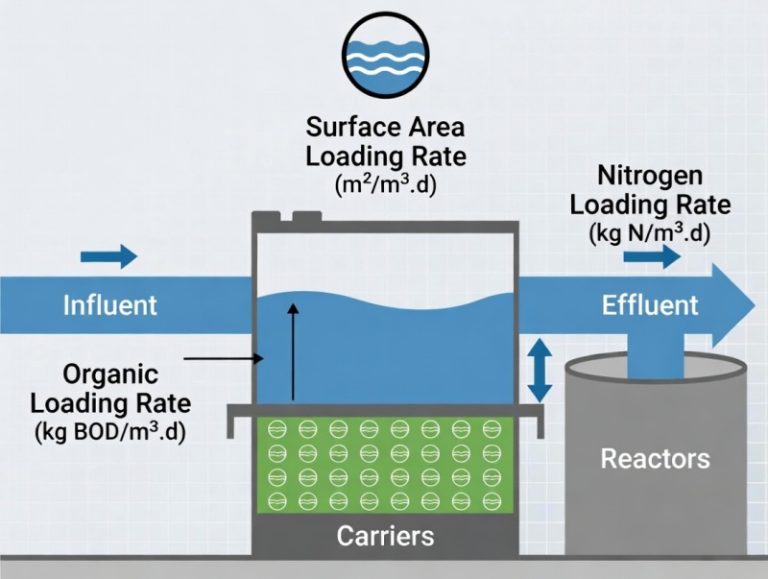


The development of mbbr moving bed biofilm bio reactor technology stems from the need to optimize traditional biofilm and activated sludge processes. While traditional biofilm methods (such as trickling filters and rotating biological contactors) have the advantages of simple operation and low operating costs, they also face issues such as biofilm detachment and clogging. Activated sludge, on the other hand, is limited by the need for sludge recirculation and complex sludge treatment. MBBR technology integrates the strengths of both methods by introducing freely moving biofilm carriers in a reactor, which not only enhances biofilm attachment and growth but also solves many of the problems associated with traditional processes.
Since its introduction in the early 1990s, MBBR technology has rapidly gained global recognition and application. Currently, over 700 MBBR systems are in use across more than 50 countries in both municipal and industrial wastewater treatment plants. With continuous technological improvements and expanding application fields, MBBR has become one of the key technologies in the wastewater treatment sector.
MBBR technology is of great significance in water treatment due to its efficiency, flexibility, and environmental friendliness. It can effectively remove organic matter, nitrogen, phosphorus, and other pollutants from wastewater. Moreover, by immobilizing microbial biofilms, MBBR reduces sludge production and lowers operating costs. Additionally, MBBR systems excel in treating high-concentration wastewater, coping with water quality fluctuations, and achieving resource recovery, providing an ideal solution for the upgrading and transformation of wastewater treatment plants.
Principle of MBBR Moving Bed Biofilm Bio Reactor
2.1 Comparison of Biofilm and Activated Sludge Processes
MBBR technology falls under the category of biofilm processes and offers significant advantages over traditional activated sludge processes. Biofilm processes involve microbial growth on solid surfaces, forming biofilms, whereas activated sludge relies on suspended microbial communities. The benefits of biofilm processes include:
- Higher sludge age, which is favorable for processes such as nitrification that require longer microbial retention times.
- Lower sludge production, reducing the costs associated with sludge treatment and disposal.
- Greater resilience to water quality and flow rate fluctuations.
However, traditional biofilm processes also have limitations, such as biofilm detachment and clogging. MBBR technology addresses these issues by introducing freely moving biofilm carriers, thereby enhancing the performance of biofilm processes.

2.2 Basic Components of MBBR Systems
MBBR systems mainly consist of an aeration tank, biofilm carriers, an aeration system, and an interception device. The biofilm carriers are the core components of MBBR systems, typically made from materials like high-density polyethylene (HDPE) with a density close to that of water (approximately 0.95 g/cm³), allowing them to float freely within the aeration tank. The aeration system not only supplies oxygen but also agitates the carriers through airflow, ensuring sufficient contact between the biofilm and the pollutants in the wastewater. The interception device prevents the carriers from escaping the reactor.
2.3 Operating Mechanism of MBBR
The operating mechanism of MBBR is based on the attachment and growth of biofilms on the carriers and the subsequent biodegradation of pollutants. The freely moving carriers provide a surface for microbial attachment and growth, forming biofilms that adsorb and degrade organic matter, nitrogen, phosphorus, and other pollutants in the wastewater. Since the biofilm is immobilized on the carriers, MBBR systems do not require sludge recirculation, simplifying the process flow and reducing operating costs.
Characteristics and Functions of MBBR Carriers
3.1 Carrier Materials and Structural Design
The materials and structural design of MBBR carriers are crucial for their performance. Common carrier materials include high-density polyethylene (HDPE) and polypropylene (PP), which offer good chemical stability and microbial affinity. The mbbr media structural design of carriers typically considers specific surface area, porosity, and carrier shape. Carriers with a high specific surface area can accommodate more microbes, forming thicker biofilms and enhancing pollutant removal efficiency.

3.2 Relationship Between Carrier Surface Area and Biofilm Growth
The specific surface area of carriers directly affects biofilm growth and treatment efficiency. Carriers with a high specific surface area can provide more attachment sites for microbes, resulting in higher biofilm loading and treatment efficiency. However, an excessively high specific surface area may lead to overly dense biofilms, affecting the transfer of oxygen and pollutants. Therefore, the specific surface area of carriers needs to be optimized based on specific treatment requirements.
3.3 Impact of Different Carriers on Treatment Efficiency
Different carrier materials and structures can significantly impact the performance of MBBR systems. Research indicates that carriers made from high-density polyethylene (HDPE) perform well due to their good chemical stability and microbial affinity. Additionally, the shape of carriers (such as spherical, cylindrical, or porous structures) also affects biofilm attachment and growth. For example, porous carriers can offer higher specific surface areas and better oxygen transfer performance, thereby improving system efficiency.

Operating Parameters and Optimization of MBBR
4.1 Influent Water Quality Requirements
The quality of influent water is crucial for the performance of MBBR systems. Generally, MBBR systems can treat various types of wastewater, including municipal, industrial, and agricultural wastewater. However, for high-concentration organic wastewater or wastewater containing toxic substances, pretreatment may be necessary to reduce toxicity and ensure stable system operation.
4.2 Dissolved Oxygen (DO) Control
Dissolved oxygen is a key operating parameter for MBBR systems. Sufficient dissolved oxygen ensures the activity of aerobic microbes and enhances the degradation of organic matter. Typically, the dissolved oxygen concentration in MBBR systems should be maintained between 2-4 mg/L. By properly designing the aeration system and adjusting the aeration rate, effective control of dissolved oxygen can be achieved.
4.3 Hydraulic Retention Time (HRT) and Sludge Retention Time (SRT)
Hydraulic retention time (HRT) and sludge retention time (SRT) are important parameters affecting MBBR system performance. HRT determines the residence time of wastewater in the reactor, while SRT influences microbial growth and metabolic processes. Generally, longer HRT and SRT are beneficial for improving treatment efficiency but may increase system footprint and operating costs. Therefore, optimization of HRT and SRT is necessary based on specific treatment requirements.
4.4 Carrier Filling Rate and Mixing Effect
Carrier filling rate is an important design parameter for MBBR systems. An appropriate filling rate ensures sufficient contact between the biofilm and wastewater, enhancing treatment efficiency. Typically, carrier filling rates range from 30% to 70%. Additionally, good mixing effects are crucial for the efficient operation of the system. By properly designing the aeration system and reactor structure, uniform suspension and mixing of carriers can be achieved.
Applications of MBBR
5.1 Municipal Wastewater Treatment
MBBR technology has been widely applied in municipal wastewater treatment. Its efficiency and flexibility make it an ideal choice for the upgrading and transformation of existing wastewater treatment plants. By installing MBBR carriers in existing activated sludge tanks, treatment capacity can be significantly increased without the need for new tanks. Moreover, MBBR systems perform well in coping with fluctuations in municipal wastewater quality and seasonal variations, ensuring stable compliance with discharge standards.
5.2 Industrial Wastewater Treatment
Industrial wastewater is typically characterized by high concentrations and complex compositions, posing higher demands on wastewater treatment technologies. MBBR technology excels in treating industrial wastewater, particularly anaerobic MBBR technology, which can effectively degrade organic pollutants in high-concentration industrial wastewater. For example, in industries such as food processing, pharmaceuticals, and chemicals, MBBR systems are widely used to treat wastewater with high organic content, not only achieving compliance with discharge standards but also reducing energy costs through biogas recovery.

5.3 Wastewater Treatment in Aquaculture and Food Processing
Wastewater from aquaculture and food processing contains large amounts of organic matter and nutrients, posing significant environmental challenges. MBBR technology performs well in treating such wastewater, effectively removing organic matter, nitrogen, phosphorus, and other pollutants. Additionally, MBBR systems can be combined with other processes (such as anaerobic digestion and advanced oxidation) to further enhance treatment efficiency.
5.4 Groundwater and Black Odorous Water Body Remediation
MBBR technology is not only applicable to wastewater treatment plants but also to the remediation of groundwater and black odorous water bodies. By installing MBBR systems in water bodies, pollutants can be effectively degraded, water quality can be improved, and the ecological functions of water bodies can be restored.
Comparison of MBBR with Other Biological Treatment Processes
6.1 MBBR vs. Conventional Activated Sludge Process (CAS)
Compared to conventional activated sludge processes (CAS), MBBR technology offers significant advantages. MBBR does not require sludge recirculation, simplifying the process flow and reducing operating costs. Additionally, MBBR systems have a longer sludge age, which is beneficial for processes such as nitrification that require longer microbial retention times. However, the investment cost of MBBR systems is relatively high and should be chosen based on specific circumstances.
6.2 MBBR vs. Sequencing Batch Reactor (SBR)
Sequencing batch reactors (SBR) are intermittent wastewater treatment processes that offer the advantages of flexible operation and low operating costs. Compared to SBR, MBBR systems can achieve continuous operation with higher treatment efficiency. Additionally, MBBR systems have greater resilience to water quality fluctuations.
6.3 MBBR vs. Membrane Bioreactor (MBR)
Membrane bioreactors (MBR) are highly efficient wastewater treatment technologies that can achieve high-quality effluent. However, MBR systems have high investment and operating costs, and membrane fouling requires regular maintenance. MBBR technology strikes a good balance between treatment efficiency and operating costs and is particularly suitable for medium-sized wastewater treatment plants.
Advantages and Challenges of MBBR Technology
7.1 Main Advantages of MBBR
MBBR technology offers several key advantages:
- High treatment efficiency: Effective removal of organic matter, nitrogen, phosphorus, and other pollutants.
- Flexible process design: Suitable for upgrading existing municipal and industrial wastewater treatment plants without the need for new tanks.
- Low sludge production: Reducing sludge treatment and disposal costs.
- Strong resilience to water quality and flow rate fluctuations.
- Independent operation: No need for sludge recirculation, simplifying the process flow.
7.2 Potential Issues and Solutions in Operation
Despite its many advantages, MBBR technology may encounter some issues during operation. For example, excessive biofilm growth can lead to carrier clogging, affecting system efficiency. Additionally, carrier wear and loss can impact system stability. These issues can be addressed by regularly cleaning carriers, optimizing aeration systems, and installing efficient interception devices.
Future Development Trends and Technological Innovations
8.1 Integration of MBBR with Other Wastewater Treatment Processes (e.g., MBR, A/O Process)
MBBR technology can be combined with other wastewater treatment processes to further enhance treatment efficiency. For example, integrating MBBR with MBR can achieve high-quality effluent, while combining MBBR with A/O processes can effectively remove nitrogen and phosphorus from wastewater.
8.2 Application of Intelligent and Automated Control in MBBR
With the development of the Internet of Things and big data technologies, the application of intelligent and automated control in MBBR systems will become a future trend. By installing sensors and automated control systems, real-time monitoring of system operation can be achieved, and parameters such as aeration rate and carrier filling rate can be automatically adjusted to further improve system efficiency and stability.
8.3 Development of New Biofilm Carriers
The development of new biofilm carriers is one of the important directions for the future development of MBBR technology. By developing carriers with higher specific surface areas, better microbial affinity, and longer service lives, the performance of MBBR systems can be further enhanced. For example, researchers are exploring the use of biodegradable and nanomaterials to develop new carriers.
Conclusion
MBBR technology, as an efficient and flexible wastewater treatment method, has a broad application prospect in municipal and industrial wastewater treatment. Its high treatment efficiency, flexible process design, and low operating costs make it an ideal choice for the upgrading and transformation of wastewater treatment plants. With continuous technological advancements and innovations, MBBR technology will play an increasingly important role in the wastewater treatment sector, providing strong support for sustainable development.