

In conventional wastewater treatment practice, Mixed Liquor Suspended Solids (MLSS) has long been used as a primary indicator of biological system performance.
Historically, many engineers assumed that activated sludge systems naturally developed a relatively stable microbial community composed of the “best-performing” microorganisms for a given influent condition.
Under this traditional assumption, temporary influent or environmental disturbances might shift biomass composition, but the microbial population would eventually return to an ideal equilibrium.
However, advances in metagenomic microbial analysis have fundamentally changed this understanding. Modern biological monitoring shows that MLSS microbial composition is highly dynamic and continuously evolves depending on operational conditions and biological growth phases.
A key framework for understanding these changes lies in ecological theory — specifically, the balance between r-strategist and K-strategist microorganisms.
What Is MLSS in Biological Wastewater Treatment?
Mixed Liquor Suspended Solids (MLSS) represents the total concentration of suspended material within the aeration basin, including:
- Bacteria and archaea
- Protozoa and metazoans
- Organic particulates
- Inorganic solids
While MLSS is commonly treated as a quantitative parameter, its true importance lies in its biological composition, not merely its concentration.
Two systems operating at identical MLSS levels may exhibit drastically different treatment efficiencies due to differences in microbial community structure.
Ecological Growth Theory Applied to Activated Sludge
Microbial populations in wastewater systems follow ecological growth principles similar to natural ecosystems. The balance between microorganism types shifts as substrate availability and environmental pressures change.
These microbial groups are commonly categorized as:
- r-strategist microorganisms
- K-strategist microorganisms
Understanding this transition provides insight into sludge health, treatment stability, and system optimization.
r-Strategist Microorganisms: Rapid Growth Specialists
Characteristics
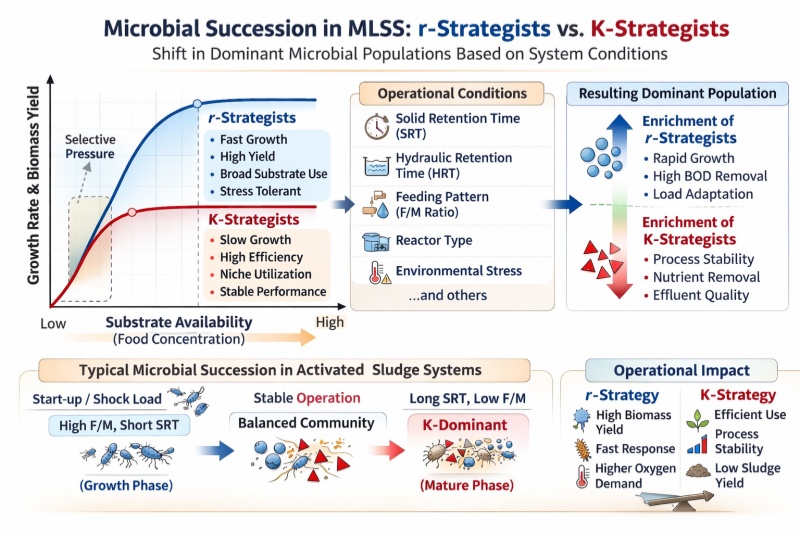
r-strategist microorganisms are adapted for environments where nutrients are abundant and competition is limited. Their defining traits include:
- Rapid reproduction and short doubling time
- High substrate uptake rates
- Ability to metabolize a wide range of organic compounds
- Strong tolerance to toxic or fluctuating conditions
- Fast biomass accumulation
Role in Wastewater Treatment Systems
r-strategists dominate during periods of:
- High organic loading (high F/M ratio)
- Plant start-up or recovery phases
- Shock loading events
- Sudden influent increases
- Early sludge growth stages
During the lag and exponential (log) growth phases, biomass expansion is largely driven by r-strategist population growth.
In operational terms, these organisms quickly consume available “food,” enabling rapid BOD and COD reduction.
Operational Implications
Systems dominated by r-strategists typically show:
- Fast sludge production
- Higher oxygen demand
- Increased biomass yield
- Potential instability under changing loads
While highly effective at rapid pollutant removal, r-dominant systems may lack long-term stability.
K-Strategist Microorganisms: Efficiency and Stability Specialists
Characteristics
K-strategist microorganisms thrive in environments where resources are limited and competition is intense. Their traits include:
- Slower growth rates
- Efficient substrate utilization
- Strong competitive ability
- Adaptation to ecological niches
- Enhanced system resilience
Role in Wastewater Treatment Systems
As substrate availability decreases and systems approach steady-state operation, selective pressure favors K-strategists.
They typically dominate under:
- Low F/M conditions
- Long sludge retention time (SRT)
- Mature activated sludge systems
- Stable operational environments
- Low residual substrate concentrations
Rather than rapid growth, K-strategists maximize resource efficiency and maintain treatment consistency.
Operational Implications
K-strategist dominance is often associated with:
- Improved effluent stability
- Better nitrification performance
- Reduced sludge yield
- Enhanced process robustness
Many nitrifying bacteria and specialized degraders fall within this ecological category.
Microbial Succession Within MLSS
Modern metagenomic studies demonstrate that activated sludge systems continuously transition between r- and K-dominant communities depending on operating conditions.
Typical biological succession may follow:
| System Condition | Dominant Strategy |
|---|---|
| Start-up Phase | r-Strategists |
| High Organic Load | r-Strategists |
| Load Stabilization | Mixed Population |
| Steady-State Operation | K-Strategists |
| Extended SRT / Low Food | K-Strategists |
This dynamic succession explains why identical MLSS concentrations do not guarantee identical biological performance.
Why MLSS Concentration Alone Is Not Enough
Traditional process control often focuses on maintaining target MLSS values. However, MLSS represents biomass quantity rather than biological quality.
Key insight:
Biological performance depends more on microbial ecology than biomass concentration alone.
Two aeration basins operating at 3,000 mg/L MLSS may differ significantly if one is dominated by fast-growing heterotrophs while the other contains stable K-strategist communities supporting nitrification and polishing.
Operational Control: Managing Microbial Strategy Balance
Wastewater operators indirectly control microbial ecology through process parameters such as:
- Food-to-Microorganism ratio (F/M)
- Sludge Retention Time (SRT)
- Dissolved Oxygen (DO)
- Hydraulic loading
- Wasting rate
- Influent variability management
Adjusting these parameters shifts selective pressure between r- and K-strategist populations.
Effective biological process control therefore involves guiding microbial succession, not merely maintaining solids concentration.
Practical Benefits for Wastewater Facilities
Understanding r/K microbial dynamics enables facilities to:
- Improve treatment stability
- Reduce sludge bulking risks
- Enhance nutrient removal
- Optimize energy consumption
- Accelerate system recovery after upset
- Improve long-term operational resilience
Conclusion
Activated sludge systems are living ecosystems rather than static biological reactors. MLSS microbial communities continuously evolve in response to operational conditions.
The interaction between r-strategist and K-strategist microorganisms provides a powerful framework for understanding biological performance, stability, and optimization.
Modern wastewater management increasingly shifts from controlling biomass quantity to managing microbial ecology, enabling more predictable and efficient treatment outcomes.