

In activated sludge wastewater treatment plants, the aeration system is the core component supporting biological processes. The membrane sheets in fine-bubble diffusers directly determine oxygen transfer efficiency (OTE), energy consumption, cleaning frequency, and overall system reliability. Ethylene Propylene Diene Monomer (EPDM) and Polytetrafluoroethylene (PTFE) are currently the two most widely used membrane materials. This article objectively compares their material properties, field performance, and selection guidelines based on real engineering cases and operational data, with emphasis on practical implications for design and long-term operation.
Basic Material Characteristics
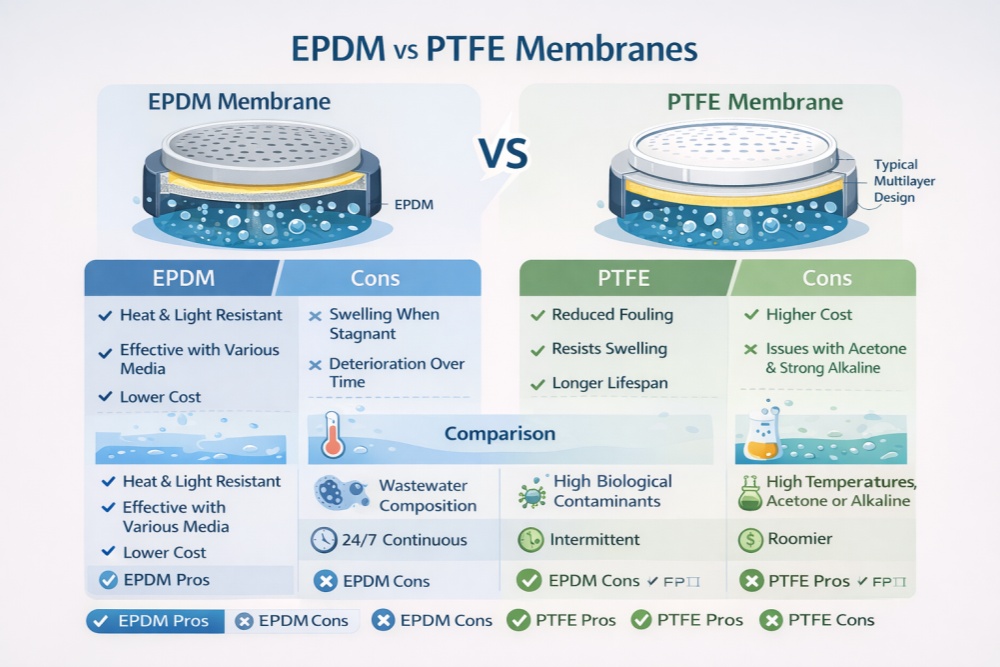
EPDM is a flexible synthetic elastomer with low density and high heat capacity. It offers excellent elasticity and fatigue resistance. Its micro-perforations can repeatedly open and close under air pressure, effectively preventing mixed liquor backflow and blockage of air passages — making it highly suitable for dynamic fine-bubble diffusers.
PTFE is a rigid fluoropolymer with very low surface energy, near-complete chemical inertness, and strong hydrophobicity/oleophobicity. In aeration applications, pure PTFE membranes are rarely used alone; instead, PTFE is commonly applied as a thin coating over an EPDM substrate, creating a composite membrane. This structure retains EPDM’s flexibility while dramatically improving surface anti-fouling and chemical resistance.
Key Performance Comparison
The table below summarizes the main engineering differences between the two membrane types in wastewater aeration applications (values represent typical ranges from municipal and industrial field data, not absolute values of any single brand):
| Item | EPDM (Standard or Enhanced) | PTFE (or PTFE-Coated Composite) | Practical Engineering Implications |
|---|---|---|---|
| Material Type | Flexible Elastomer | Rigid Fluoropolymer (often coated) | EPDM suits high mechanical cycling; PTFE better for static chemical attack |
| Operating Temperature Range | -40 ~ 120–150 °C | -200 ~ 260 °C | >90 °C or hot industrial streams → must use PTFE; EPDM degrades rapidly |
| Chemical Resistance | Good against water, weak acids/bases, salts; poor against oils, hydrocarbons, strong solvents | Nearly inert to acids, bases, solvents, oils | FOG, solvents or extreme pH industrial waste → EPDM fails in 1–2 years; PTFE lasts 10+ years |
| Fouling Resistance | Moderate (hydrophilic surface attracts biofilm & organics) | Excellent (low surface energy; fouling rate 5–10× slower) | PTFE significantly extends cleaning intervals, reduces chemical and downtime costs |
| Elasticity & Pore Dynamic Response | Excellent (repeated opening/closing without fatigue, prevents backflow) | Poor (higher rigidity; pure PTFE unsuitable for high-frequency flexing) | Frequent on/off or variable-load aeration → prefer EPDM; stable-flow MBR/industrial tanks → PTFE viable |
| Initial Standard Oxygen Transfer Efficiency (SOTE) | Good (fine bubbles 1–3 mm) | Good to higher (depending on coating uniformity) | Initial performance similar; PTFE decays much slower over time |
| Typical Service Life | Municipal: 5–8 years; Harsh industrial: 1–3 years | Municipal: 8–12 years; Harsh industrial: 10+ years | In aggressive conditions, PTFE lifecycle cost is far lower than frequent EPDM replacement |
| Initial Procurement Cost | Low (benchmark) | High (2–5×) | Tight budget + mild water → EPDM; Long-term priority → PTFE |
| Maintenance Frequency | Higher (more frequent CIP required) | Lower (longer cleaning intervals) | PTFE reduces labor & chemical consumption; may require specialized cleaning protocols |
Key Considerations in Operation and Design
- Wastewater Composition Determines Material Baseline
Municipal/domestic or low-industrial wastewater → EPDM is the most economical choice. Real case: a medium-sized municipal plant replaced 20,000 EPDM diffusers at ~30% of PTFE cost, projected 7-year life with low fouling and stable operation. - Temperature and Mechanical Stress Trade-off
High-temperature streams immediately exclude EPDM. Frequent start/stop or large flow variations favor high-quality PTFE-coated EPDM composites, preserving elasticity while gaining surface protection. - Total Cost of Ownership (TCO) Driven Selection
TCO ≈ Initial Cost + (Annual OPEX × Years)
Mild conditions → EPDM lowest TCO; Aggressive conditions → EPDM replacement & high OPEX drive TCO up sharply; PTFE often saves multiples over 10 years. - Retrofit and Transitional Scenarios
For existing plants, applying PTFE coating directly onto aged EPDM membranes avoids full diffuser/piping replacement — a cost-effective upgrade for industrial-municipal mixed influents.
Conclusion
EPDM and PTFE membranes each have clear engineering roles — there is no universal “better” option, only better fit. In standard municipal, low-temperature, low-FOG scenarios, EPDM wins on cost-effectiveness and mechanical reliability. In industrial high-temperature, oily/solvent-laden, highly corrosive, or ultra-low-maintenance environments, PTFE (especially coated composite types) delivers irreplaceable long-term stability. Real-world selection must be based on detailed influent analysis (FOG, pH, temperature, solvent types) combined with full lifecycle cost calculation — never decide based solely on initial price quotes.