

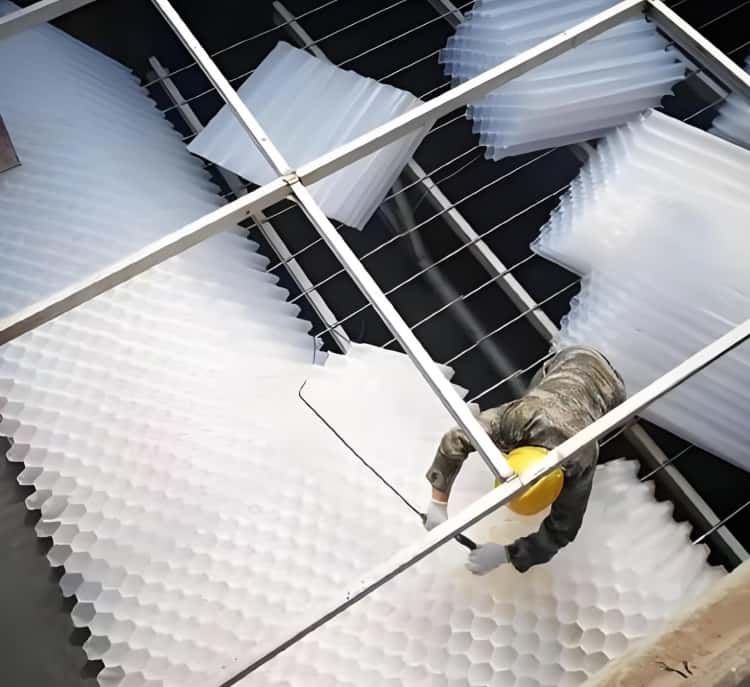
The Tube Settler System is a modular clarification solution designed to enhance solid-liquid separation efficiency in sedimentation tanks.By utilizing multiple inclined tubular channels set at a fixed 60° angle, the tube settler increases effective settling surface area and significantly shortens particle settling time compared to traditional clarifiers. Available in both PP and PVC materials, this product is engineered for durability, structural stability, and long service life under harsh environmental conditions.
Key Features
- High Settling Efficiency: 60° inclination promotes optimal sedimentation trajectory while ensuring self-cleaning effect.
- Space-Saving Design: Compact lamella modules maximize hydraulic capacity within limited tank volumes.
- Durable & Chemical Resistant: Manufactured from UV-resistant, corrosion-proof polymer (PP or PVC).
- Customizable Assembly: Adaptable to various tank sizes and structural layouts.
- Fast Installation: Pre-welded panels allow for rapid deployment on-site.
Material Options & Assembly Methods
| Material | Characteristics | Assembly Method |
|---|---|---|
| PVC | Easy to cut and glue; suitable for low to medium load systems | Industrial adhesive bonding |
| PP | Stronger and more durable; ideal for large-scale or high-strength systems | Hot air welding or iron soldering |
Standard Installation Procedure
- Site Preparation
– Verify tank dimensions and base level tolerance (±5mm/m²)
– Confirm sludge pipe layout and integrity - Support Frame Installation
– Weld galvanized or stainless brackets at a 60° angle
– Conduct load tests at 150% of design load
– Apply epoxy coal-tar coating (≥250μm) - Module Assembly
– Assemble 1m² panels using infrared or iron welding (PP) or adhesive (PVC)
– Maintain consistent orientation and prevent warping - Module Placement
– Install from left to right using laser alignment
– Fix panels with dual 10mm stainless steel crossbars
– Seal gaps with expansion joint sealant - System Integration
– Connect inlet distribution and outlet weirs
– Adjust weir height within ±2mm - Commissioning
– Gradually increase flow over 72 hours
– Monitor sludge formation and performance
Technical Specifications
| Parameter | Specification | Purpose |
|---|---|---|
| Inclination Angle | 60° ±1° | Optimal particle settling |
| Cell Spacing | 80–100 mm | Balances flow and SS removal |
| Surface Loading Rate | 0.5–0.7 mm/s | Prevents particle resuspension |
| Sludge Layer Height | ≤1.0 m | Maintains hydraulic performance |
| Freeboard Depth | 0.5–1.0 m | Controls turbulence and overflow |
Operation & Maintenance
- Weekly: Inspect for biofilm buildup
- Quarterly: Check for module integrity
- Annually: Inspect and maintain anti-corrosion protection
- Best Practice: Maintain residual chlorine at 0.3–0.5 mg/L
Frequently Asked Questions
Q1: Why is the 60° angle critical?
It offers the most efficient settling path while ensuring self-cleansing action.
Q2: What is the expected service life?
Properly maintained modules last 10–15 years. Replacement is needed if you see UV cracks, 5% deformation, or performance drop.
Q3: Best practices for cold regions?
Use -20°C rated PP, install sludge heaters, and increase freeboard to 1.2 m to accommodate ice expansion.
Contact Us
Need help or installation videos? Our engineers are ready to assist.